AI is currently affecting the choices at the heart of the contemporary business, including recruiting and pricing, customer care, and risk evaluation. Such influence cannot be achieved by mere experimentation. Every serious business owner or executive must ensure clear governance. An AI use policy establishes the scope and location of AI applications and provides organisational limits on risk, responsibility, and use of data.
It contains the AI Code of Conduct, which transforms principles into day-to-day practice. It directs groups on ethical architecture, conscientious implementation, and human management. Expansion of AI between teams, vendors, and regions would guarantee uniformity, safeguard stakeholders, and create confidence. That allows innovation without being compromised by integrity in the long run.
What Is an AI Code of Conduct, and Why Does It Matter?
An understanding of appropriate human behaviour when creating, implementing, acquiring, or interacting with AI systems is known as a code of conduct. It creates clear expectations at the points when it is most important to be ethically judgmental. An AI Use Policy is required to decide whether AI can be applicable in a particular context, but the AI Code of Conduct describes the manner in which such decisions should be made in the scenario when the use has been sanctioned. This difference is essential since the majority of AI risks are manifested in the process of data selection, model design, tuning, and interpretation rather than the technology itself.
An effective code of conduct for AI will tend to deal with:
• Openness, ensuring AI outputs are comprehended, explained, and criticised
• Bias reduction to mitigate the risk of unfair and discriminatory results
• Responsibility leading to the attribution of AI-aided decision-making
• Ability to control privacy and data protection regarding the source, usage, and retention of sensitive data
The code puts ethics into action in practice. In implementing an AI-driven recommendation system, it directs the data analysis, stipulates when human analysis is needed, and puts restrictions into clear communication.
How the AI Code of Conduct Fits into Your Enterprise AI Use Policy
The code of conduct for AI is basically the behavioural level of an enterprise's Artificial Intelligence Use Policy. Through the policy, there is a definition of governance, risk levels, and approval procedures. Those controls are translated into the code of conduct that directs the decisions made daily. This difference is important since AI risk can occur most frequently during design decisions, data processing, and interpretation, but not at the policy level.
Behavioural standards are also needed in large organisations with decentralised AI applications. They minimise variability among teams, stop policy drift, and facilitate decision support in the face of regulatory review. Definitive moral codes are also effective in reducing malpractice, enhancing responsibility, and establishing customer, employee, and government trust.
Some ethical principles usually enshrined in the code of conduct for AI are:
• Human control over high-impact or irreversible decisions
• Equality in data, models, and results
• Regulated, customer, or internal decision system explainability
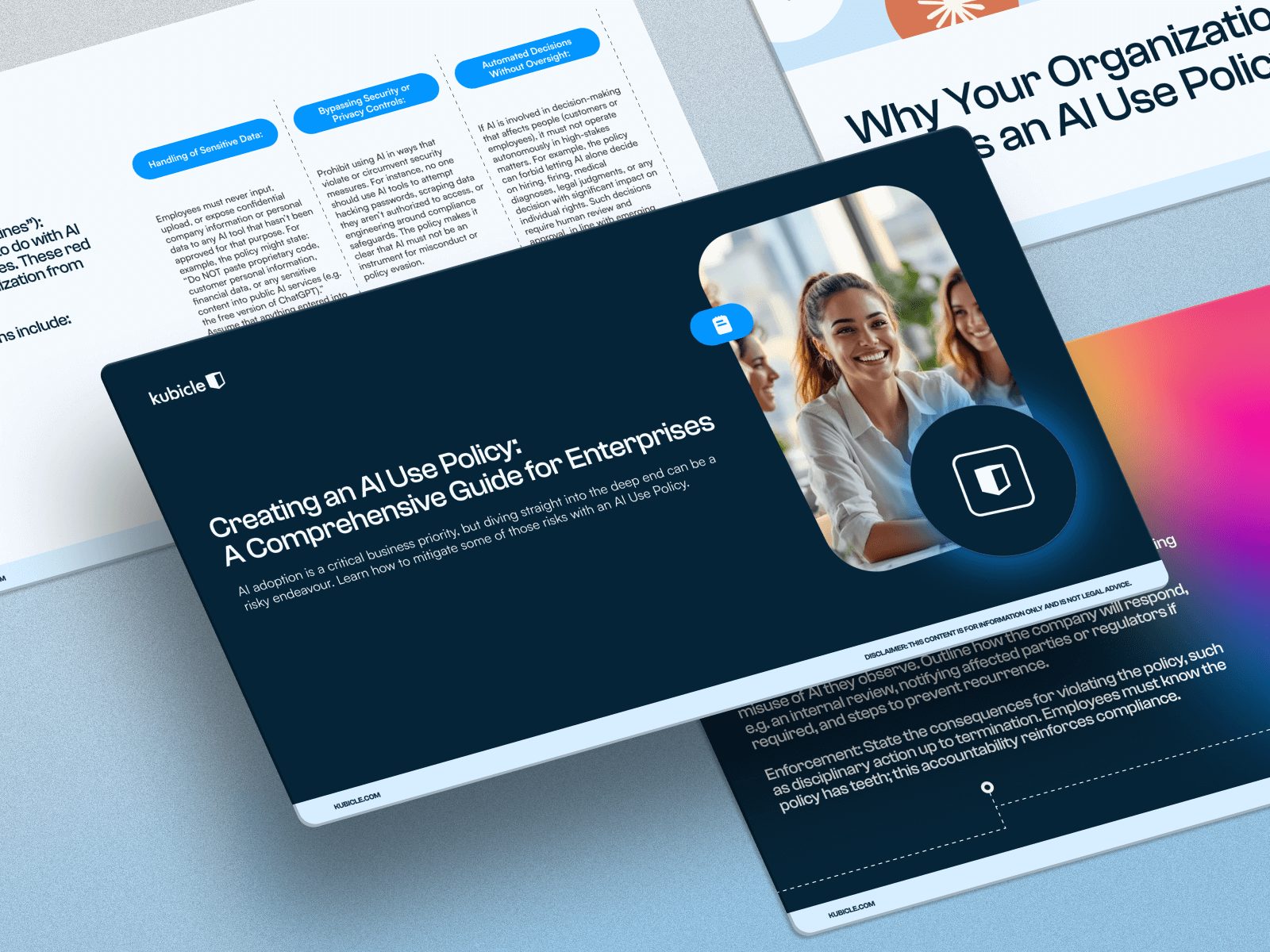
To reinforce such integration, the downloadable AI Use Policy Framework offered by Kubicle provides a realistic structure for harmonising the AI governance with ethical conduct. It assists organisations in developing defensible and scalable AI policies.
Key Benefits of Implementing an AI Code of Conduct in Your Business
A Code of Conduct of AI provides real business value. It enhances governance, mitigates risk exposure, and prepares organisations to scale AI boldly as regulatory and stakeholder requirements increase.
Ethical Risk Management and Data Protection
Ethical guidelines allow for minimising the risk of biased results, misuse of data, and uncontrolled experimentation. Organisational setting of expectations regarding data selection, model evaluation, and human review will avoid problems before they turn into an incident. Companies that have formalised the AI ethics codes have fewer ethical violations, reduced compliance risk, and increased customer confidence, especially with the growth of generative AI beyond technical organisations.
Compliance and Adherence to the Regulations
New rules are demanding more and more evidence of ethical governance, rather than technical protection. The intent, accountability, and oversight of a documented code of conduct for AI assist organisations in meeting regulatory expectations like those set by the EU AI Act, and acting efficiently in any audit and investigation. This will minimise legal ambiguity and exposure to penalties, hampering operations and loss of reputation.
Operational Transparency to Create Trust
Openness enhances integration and builds trust. AI collaborates well with the employees in situations where decision-making boundaries are evident. Customers, partners, and regulators will tend to trust the AI-driven outcomes when organisations can explain their method of controlling and reviewing decisions. Organisations with strong AI principles models excel in the domains of trust, adoption, and long-term AI value compared to others.
All these advantages build a strong foundation for governance that facilitates growth, as opposed to limiting it.
Steps for Implementing an AI Code of Conduct in Your Organisation
A code of conduct for AI must be embedded with the help of legal, technological, human resources, and business leadership. It is not aimed at bureaucracy but consistency.
Perform Specific Risk Evaluation
Risk assessment determines the location of possible pitfalls of the introduction of AI that may create ethical, operational, or regulatory risk even before it takes effect. The teams review systematically AI use cases, data sources, decision paths, and stakeholders involved in the decisions to comprehend the impact of AI. The application techniques would be cross-functional workshops, a mapping system, impact assessment, and orderly risk scoring, with high-impact or high-exposure systems given priority.
The cases of AI automation of decisions, their impact on the rights of people, and those who use sensitive data should be given special attention. When these assessments are done early, it will be possible to base the AI Code of Conduct on actual business risks as opposed to abstract principles. It enables organisations to prioritise controls where they are most needed and minimise the chances of biased results, privacy invasion, or compliance breakdowns following deployment.
Provide Role-Specific AI Ethics Training
Role-specific AI ethics training is an effort to understand Artificial Inteligence in the workplace. The training must mirror the interactions between the different roles and AI through the real workflows, the common points of failure, and the simulation of scenarios. Developers require instructions on data selection, testing, and model restrictions. The owners of the products have to know their responsibility and influence on users.
Procurement departments must have guidelines on how to assess third-party AI, and end users must have a clear understanding of how to rely and escalate properly. Custodial training makes the employees familiar not only with the rules but also with their application in actual cases. This creates trust and minimises unsteady behaviour as well, and instils moral judgement in the routine processes.
Implement Governance and Ongoing AI Assurance
As AI systems evolve, the formulation of governance, oversight, and review mechanisms will ensure that ethical compliance is obtained. The AI also has a transparent ownership of the organisations, defines the escalation paths, and establishes the review points throughout the lifecycle of the AI. Regular model, data, and result reviews help identify drift, unintended results, or risk profiles. Regular checks and balances ensure that certain AI is aligned with the organisational values and ready to meet the regulations, and allow the Code of Conduct to be efficient as the adoption of AI grows.
Enhancing Your AI Use Policy with Ethical Guidelines
Informal norms no longer give sufficient protection as AI gets integrated into the daily decision-making process. A copy of the AI code of conduct, which is part of a well-elaborated AI Use Policy, provides organisations with a sustainable guide to responsible scale.
The incorporation of AI Literacy programs will be more predictable and defendable when the ethical concept, governance, and training are mutually supported. This consistency over time also raises the quality of decisions, as the teams become accustomed to doubting AI in the same manner they would doubt a financial or legal decision.
Businesses looking to strengthen AI adoption are encouraged to explore Kubicle’s training solutions and contact the team for tailored guidance on building a robust AI governance framework that supports long-term value and accountability.
Related: codes of conduct rely on AI-literate staff. See our guide to EU AI Act training and AI literacy requirements for building that capability.