A graduate program that accelerates work-readiness.
Help your recent graduates develop a clear path to success with a program built around real
skills, practical tools, and guided projects. With Kubicle, your workforce ramps up faster,
retains more of what they learn, and makes an impact straight away.
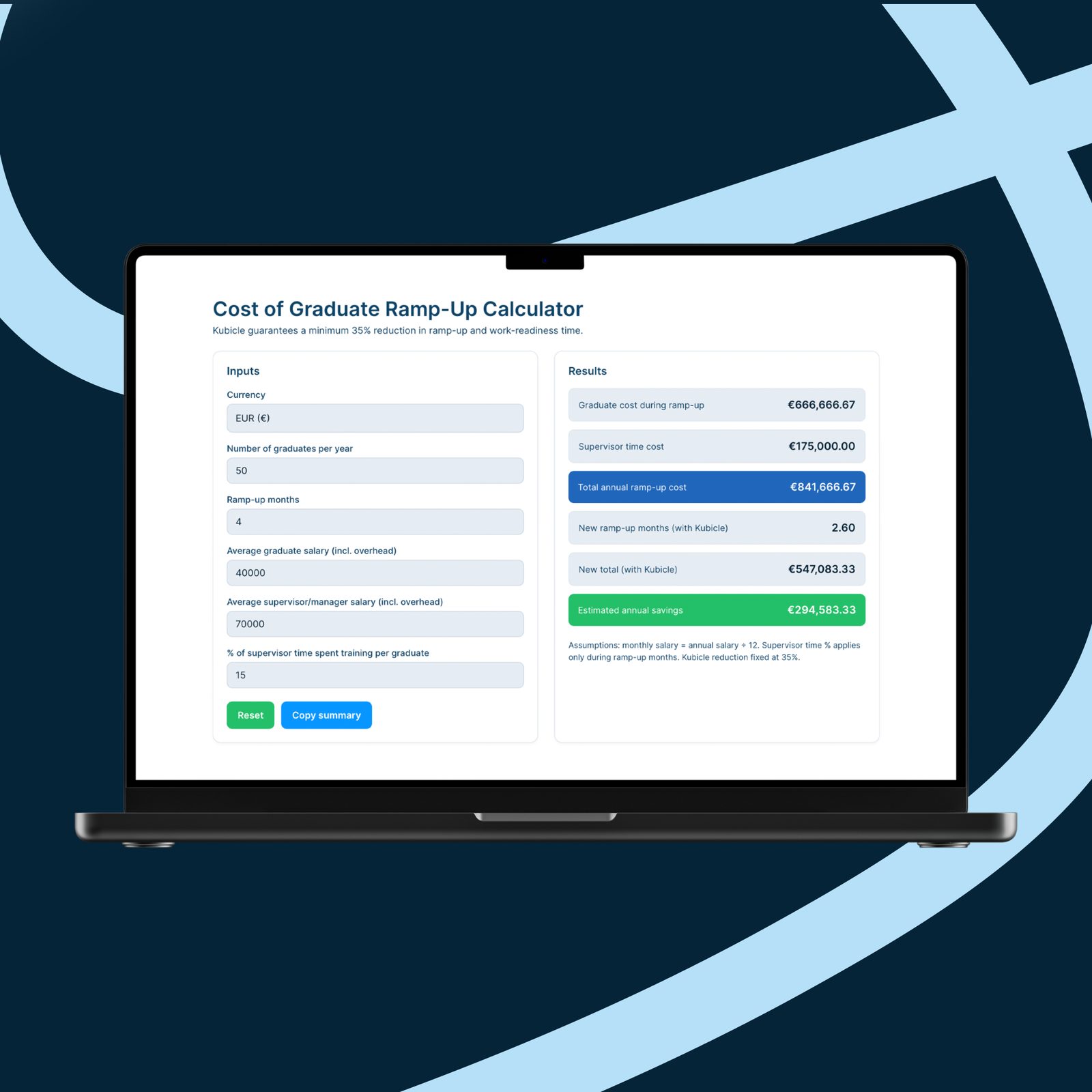
Recent graduates onboarded with Kubicle stay longer and start project work up to 35% faster.
A structured, role-mapped pathway closes the work-readiness gap weeks earlier than ad-hoc
training programs.
35%Faster time to first project
86%Course completion rate
10xFaster learning outcomes
What We Deliver
How Kubicle beats every other graduate work-readiness program.
Recent graduates often arrive eager but underprepared for the realities of the workplace. Kubicle
closes that gap with targeted skill-building and smart learning tools, helping your new hires
settle in faster and contribute sooner, while ensuring consistent results across your organization.
The right skills, for the right roles
Five role-mapped semesters covering the Modern Office Toolkit, Data Literacy, Strategy and
Project Management, Business Finance, and Data Analysis. Built specifically for the intern,
graduate and early-career hire.
Skill diagnostics for recent graduates
Built-in skills assessments pinpoint the precise training each graduate requires. This targeted
approach reduces wasted learning time, accelerates performance, and delivers measurable value to
the organization.
Speed and consistency in a graduate setting
A guaranteed minimum 35% reduction in ramp-up time, with consistent outcomes across cohorts,
regions and business units. Every grad lands with the same baseline of fluency.
Who this is for
Two graduate personas, four academies, one pathway.
The Kubicle Graduate Development Program is calibrated to two distinct early-career personas. Each
pathway stacks the right tier of AI, Data, Project Management and Finance academies against the
role, so new hires arrive with the exact fluency the job demands.
Program · Entry-level
The intern and graduate
The 12 months before placement and the first year of work. Baseline fluency across all four
academies that every entry-level role now expects on day one.
AI Apprentice AI
Data Citizen Data
Project Member PM
Finance Apprentice Finance
Year 1 to 2
The early-career hire
First analyst, coordinator or associate role. Needs broad fluency fast: enough AI, data,
project sense and finance to operate from day one.
AI Navigator AI
Data Associate Data
Project Member PM
Finance Apprentice Finance
Curriculum
What's included in Kubicle's Graduate Development Program.
Five sequenced semesters take a new hire from spreadsheet basics through to building dashboards
that influence real business decisions. Each semester is anchored in Kubicle's accredited
subject library.
Semester 01
The Modern Office Toolkit
Day-one productivity in the tools every business uses
Spreadsheet foundations
Confidence in Excel through data entry, formulas, formatting, and basic analysis. Learners
organize information, create charts, and turn data into insights that support everyday
decision-making.
The ability to produce polished reports and impactful slide decks. Learners practice
structuring ideas clearly, applying professional formatting, and using visuals effectively.
Manage Outlook emails, calendars, and contacts with confidence. Learners acquire professional
writing skills and learn how to find files in SharePoint, adopting habits that make
collaboration smoother from day one.
A strong conceptual understanding of data and ethics
Core data concepts
Graduates develop a clear understanding of data types, structures, and key principles that
underpin modern business. They learn how data is stored, organized, and applied across
everyday workplace tasks.
Responsible data handling, including security, privacy, and compliance standards. Learners
understand how to manage data ethically and protect sensitive information in line with company
policies.
Critical thinking skills to interpret data and make stronger decisions. Graduates practice
data-driven storytelling, learning how to turn numbers into clear, actionable insights.
Understanding Basic Strategy and Managing Projects
Drive success by planning and executing projects effectively
Introduction to business strategy
How internal and external factors influence business performance. Learners explore key
strategic concepts that shape decision-making in competitive environments.
How to conduct research that supports business goals. Learners practice planning research
projects, gathering reliable information, and turning findings into actionable insights.
The ability to write clear, credible reports that support business decisions, paired with
foundational project management. Learners structure content, present evidence and run a clean
project plan.
Commercial awareness to make smart business decisions
Principles of statistics
Core statistical concepts and methods used in everyday business. Learners interpret data,
identify trends, and apply statistics to support decision-making.
The fundamentals of corporate finance, focusing on financial statements and ratios. Learners
understand how finance professionals use these principles to guide business strategy and
performance.
How to read and interpret income statements, balance sheets, and cash flow statements.
Graduates gain the ability to connect financial data with real business outcomes.
Turn raw data into actionable insights with industry-standard tools
Visualization fundamentals
Principles of visual hierarchy and how to apply them when creating charts and dashboards.
Learners understand how design choices influence clarity, accuracy, and impact.
Turning visualizations into compelling stories. Graduates practice presenting charts and
graphs in a way that highlights key insights and supports better business decisions.
A foundational understanding of the leading data visualization tools in business today.
Learners build simple dashboards that communicate insights effectively.
Hear it from the people who lived it. Two recent graduates on how Kubicle changed how they showed up in their first months on the job.
I came in with the degree but not the workplace skills. The semester structure meant I always knew what to learn next, and the projects gave me real evidence I could point to in reviews.
Jack · Recent Graduate
Kubicle gave me the exact skills the business actually wanted on day one. By the end of my first month I was running my own analysis in Excel and Power BI without supervision.
Eric · Recent Graduate
Case studies
How leading teams have used Kubicle's Graduate Development Program.
Got a question about our development program for recent graduates? You are in the right place.
Whether you are curious about the curriculum, pricing, certifications, or platform features, the
common queries are below. If you do not find what you are looking for, our team is here to help.
Kubicle is designed for enterprise teams. The Graduate Program covers Excel, Power BI, SQL,
financial modeling, Project Management, AI fundamentals and more across five sequenced
semesters. With over 1,000 practical video lessons, real-world projects and bite-sized modules,
recent graduates onboard faster, work more efficiently, and deliver strategic insights, with up
to 40% improvements in efficiency and learning outcomes up to 10x faster.
Absolutely. Our learning pathways offer structured journeys tailored from beginner through to
advanced users. Organizations can mix and match based on role, making it ideal for hybrid
cohorts and rotational programs.
Our library spans essential business tools and domains: Excel, PowerPoint, Power BI, Tableau,
SQL, Python, Alteryx, RPA tools, AI fundamentals and business communication skills, covering
both technical and applied soft skills.
Typical rollouts complete in about a week, and can be as quick as a day. It depends on your
urgency. Your newly hired graduates get expert onboarding support and a dedicated customer
success manager to ensure smooth setup and ongoing engagement.
Yes. Kubicle's semesterized, bite-sized format drives strong engagement, with roughly 86%
completion rates and high learner satisfaction. Real-world projects, certificates, and
recognized credentials (CPE, CPD, NASBA) reinforce motivation and trackable achievement.
Kubicle supports integrations with major Learning Management Systems (like Degreed and
Cornerstone) and features enterprise capabilities such as bulk user management, SSO, reporting
and data tracking.
Yes. Every course exam earns certificates accredited by CPD, CPE and NASBA, which learners can
share on LinkedIn or use for professional development credits.
Kubicle content is regularly refreshed to reflect the latest versions and best practices in
tools and analytics. Clients appreciate that learning is always both current and relevant.
You will be supported end-to-end. Our team provides strategic planning, onboarding, regular
check-ins, and tailored curriculum advice based on your team's goals, with options for branded
or custom learning pathways.